



Autumn Sale - Ends Sunday - 100% Pure Cotton bedding range, and luxurious handmade 100% European linen bedding.
Crafted for comfort. Priced for a limited time.

Quick answer: Flat sheets are less common in Europe because many Europeans sleep directly beneath a washable duvet cover, creating a simpler bed with fewer layers and less bedding to manage.
Ask a European and an American how to make a bed and you may get two surprisingly different answers.
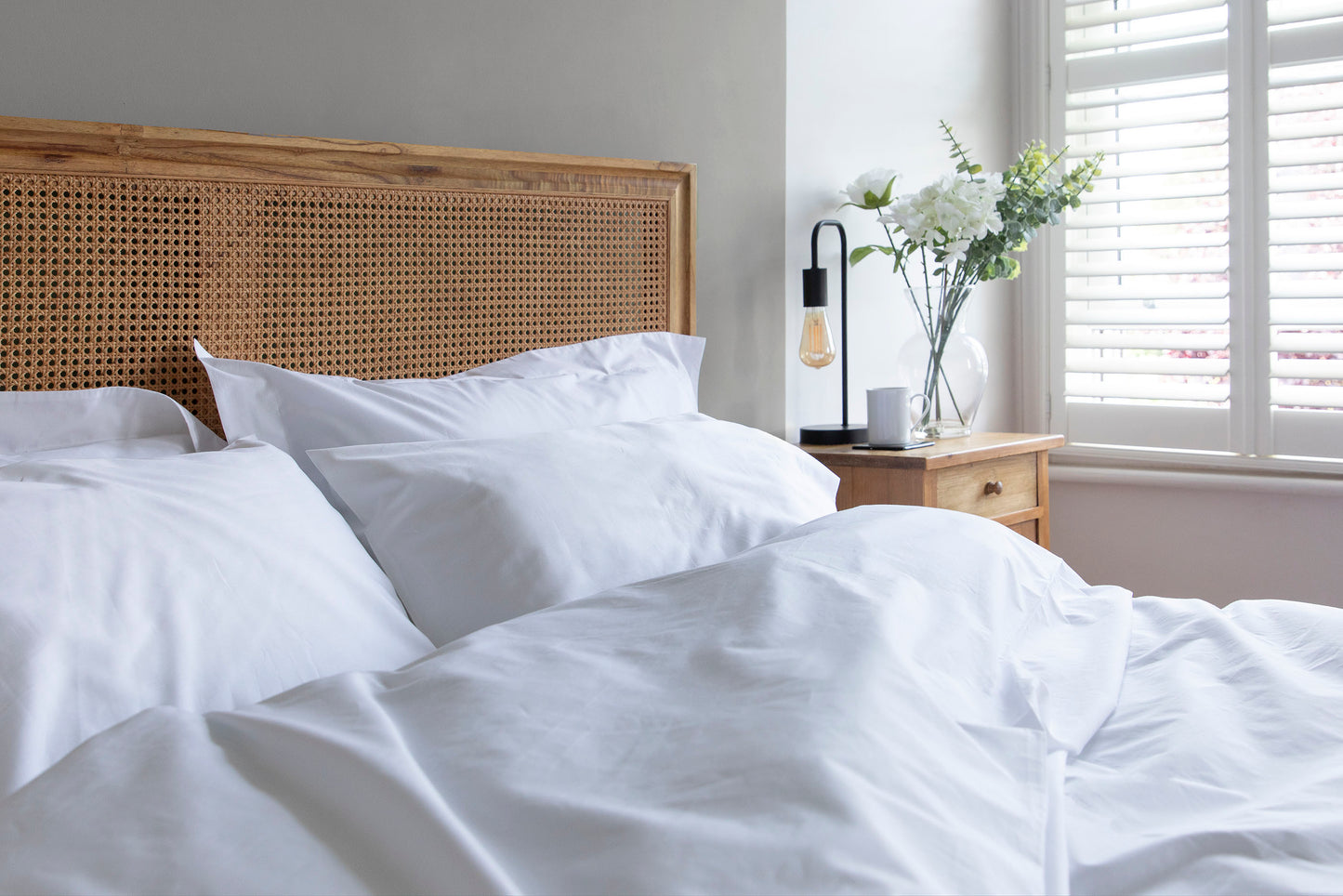
In much of the United States, the traditional arrangement is a fitted sheet, a flat or top sheet, and then a comforter or duvet. Across many parts of Europe and increasingly in the UK, the flat sheet is often missing altogether. Instead, the sleeper lies on a fitted sheet with a duvet inside a removable, washable duvet cover directly above them.
It has even created something of a top sheet debate: is a flat sheet an essential part of a properly made bed, or simply an extra piece of fabric to wash, iron and become tangled in during the night?
Having sold cotton bedding, linen bedding, fitted sheets, flat bed sheets, duvet covers and complete bedding sets, I've found the answer is less about one system being "correct" and more about how bedding traditions developed — and how people actually want to sleep.
A flat sheet is simply a rectangular bed sheet without elasticated corners. When used as a top sheet, it sits between the sleeper and their duvet, blanket or comforter.
This creates two distinct bedding systems.
The traditional layered system is:
The simpler European bedding arrangement is usually:
Neither arrangement is inherently better. The important difference is that in the second system, the duvet cover itself becomes the washable layer that touches your body.
Sleep Foundation describes the top sheet as a barrier between the sleeper and comforter and notes that, although top sheets have traditionally been standard in the United States, they are uncommon in Europe. It also notes that some Americans are now abandoning them. Sleep Foundation – Do You Really Need a Top Sheet?
There isn't one single explanation for the flat sheet Europe divide. Cultural habit certainly matters, but I think practicality explains why the duvet-and-cover system has endured.
A duvet cover isn't merely decorative. It is removable and washable, meaning you don't necessarily need another washable layer between yourself and the duvet.
That changes the purpose of the flat sheet.
If you're sleeping beneath a comforter that isn't regularly washed or doesn't have a removable cover, a top sheet makes considerable sense. If you're sleeping beneath a duvet enclosed within a washable cotton or linen duvet cover that goes into the washing machine with your other bedding, the flat sheet starts to become optional.
That distinction is at the heart of the European bedding tradition.
If you're unfamiliar with the European approach, our guide to how duvet covers work explains exactly how the duvet and removable cover work together as a bedding system.
Personally, I've gone through phases with flat sheets.
When I was younger, I associated them with a "properly made bed": neatly layered bedding with the sheet tucked tightly underneath the mattress, rather like the beds you encounter in traditional hotels.
In everyday life, however, I found them irritating.
They bunch up. They slide around. They can wrap themselves around your legs. And ultimately there is another large piece of bedding to wash, dry, fold and potentially iron.
As I've got older — and busier — I've stopped using them completely.
For me, a fitted sheet and duvet cover is cleaner, quicker and more comfortable. I also sleep warm, so I prefer fewer layers between myself and the duvet.
There's another benefit that doesn't get mentioned enough: you actually feel the fabric you chose to buy.
If you've deliberately selected crisp cotton percale, smooth cotton sateen or stonewashed linen because you enjoy how that particular textile feels, putting another sheet between you and the duvet cover changes the experience.
Our experience selling bedding in the UK reflects the broader European preference surprisingly closely.
The overwhelming majority of the bedding combinations we encounter consist of a fitted sheet, duvet cover and pillowcases. Flat-sheet enquiries represent only a very small proportion of our customer conversations — roughly 1–2%.
When people do ask about flat sheets, they tend to fall into three broad groups:
Our European manufacturing experience reinforces this. Flat sheets tend to be regarded as a much more specialist requirement, while the duvet-cover system is simply assumed.
That doesn't prove that one approach is superior. It does show how deeply bedding habits vary between markets.
Potentially — but fabric choice matters more than simply counting layers.
Every additional textile layer can influence how a bed feels, but breathability, weave, fabric weight and moisture management are also important.
Sleep Foundation identifies cotton and linen among the materials suitable for sleepers looking for breathable bedding. It also highlights cotton percale as particularly airy because its one-over, one-under construction allows air to move relatively easily through the fabric. Sleep Foundation – Best Material for Bed Sheets
This is why someone who sleeps warm may notice a considerable difference between crisp cotton percale bedding and a heavier synthetic alternative.
Percale and sateen shouldn't be confused simply because both can be made from cotton, either.
Percale typically feels crisp, matte and airy. Sateen uses a different weave structure to produce a smoother, silkier and slightly denser fabric. Sleep Foundation similarly notes that sateen generally provides more warmth than percale. Sleep Foundation – Tencel vs Cotton Sheets
Linen takes another route. Made from flax fibres, linen is known for breathability and moisture management and can be particularly attractive to people who sleep warm. Sleep Foundation – Linen Sheets
So if temperature is your concern, I'd look at what your bedding is made from before worrying too much about whether Europeans use a top sheet.
Once the duvet cover becomes the fabric directly against your body for perhaps seven or eight hours a night, its construction and provenance deserve attention.
For cotton bedding, certification can help distinguish substantiated claims from marketing language.
The Global Organic Textile Standard (GOTS) covers textile processing involving certified organic fibres and incorporates environmental and social requirements through the supply chain. Its "organic" label grade requires at least 95% certified organic fibres. Global Organic Textile Standard – Certification and Labelling
OEKO-TEX® STANDARD 100 approaches the question differently. It tests textiles for harmful substances, with requirements becoming stricter as the degree of skin contact increases. Bed linen falls within its direct-skin-contact product category, and certified components are tested against a list of more than 1,000 harmful substances. OEKO-TEX® STANDARD 100
These standards don't tell you whether to sleep with a top sheet. They tell you something much more useful: what independent requirements the textile itself has met.
The relationship between Europe and linen goes much deeper than modern bedding fashions.
Flax has a substantial European cultivation and textile heritage. The certification formerly known as European Flax™ has evolved into Masters of FLAX FIBRE™, which certifies the European origin and traceability of flax fibre through the supply chain.
The Alliance for European Flax-Linen & Hemp states that certified flax originates in Western Europe — principally France, Belgium and the Netherlands — with traceability based upon chain-of-custody requirements. Alliance for European Flax-Linen & Hemp – Masters of FLAX FIBRE™
Linen's appeal isn't limited to its European heritage either; its breathability, durability and distinctive feel help explain the benefits of linen bedding for year-round use.
For consumers comparing European linen bedding, that type of traceability is considerably more meaningful than vague phrases such as "European style" or "luxury linen".
Despite not using one myself, I wouldn't declare the flat sheet redundant.
There are situations where it's genuinely useful.
This is the occasion when I still appreciate one.
I've experienced nights abroad when even a lightweight duvet felt excessive, but sleeping completely uncovered didn't feel comfortable either. A breathable cotton or linen flat sheet can provide just enough covering without the insulation of a duvet.
A flat sheet gives guests options.
Someone can sleep underneath the sheet alone, beneath the sheet and duvet together, or move the duvet aside entirely.
It can also provide an additional washable barrier between the sleeper and bedding above.
A top sheet can help reduce direct contact between the sleeper and the duvet cover.
Sleep Foundation recommends washing sheets and pillowcases approximately weekly as a general guideline, while duvet covers may typically be washed every two weeks to a month, depending on use and individual circumstances. Sleep Foundation – Bedding Guide
If a flat sheet helps someone maintain a practical bedding-care routine, that's a perfectly good reason to use one.
Comfort isn't purely technical.
Some people genuinely enjoy sliding into a crisply made bed with a tightly tucked top sheet. Others — myself included — spend half the night trying to kick it loose.
Neither group is wrong.
If someone asked me whether they should buy a flat sheet, I wouldn't automatically recommend one.
I'd ask how they sleep.
If you're a hot sleeper: start with breathable bedding and fewer layers. Cotton percale or linen can be particularly useful choices. A flat sheet can then become an excellent duvet substitute on exceptionally warm nights.
If you're a cold sleeper: a flat sheet isn't necessarily going to add meaningful warmth. Your duvet's tog rating and the materials surrounding you are likely to matter more.
If you love linen: I'd be inclined to let the linen duvet cover sit directly against your skin. Part of the pleasure of good linen bedding is its distinctive texture and ability to manage moisture.
If it's a guest bedroom: a flat sheet is worth considering because it gives different sleepers more choice.
If you love hotel-style bedding: use one. There is no reason to abandon a bedding arrangement you genuinely find comfortable simply because another system is more popular elsewhere.
Not if the duvet cover is treated as washable bed linen rather than decoration.
The important principle is straightforward: the textile in regular contact with your body needs regular laundering.
This is also where material quality matters. Bedding is repeatedly exposed to washing, drying, body oils, moisture and movement, so natural-fibre bedding needs to balance comfort with durability.
Cotton remains one of the most widely used bedding fibres partly because it is breathable and relatively straightforward to care for. Linen is also highly durable and generally becomes softer through repeated use and washing. Sleep Foundation – Best Material for Bed Sheets
A simpler bed doesn't have to mean a less hygienic one. It simply changes which layer you wash.
So, why don't Europeans use flat sheets?
Many do — Europe is far too diverse for an absolute rule — but the flat sheet is considerably less central to European bedding than it has traditionally been in America.
The likely explanation isn't one obscure cultural custom. It's the development of a bedding system centred around a duvet with a removable, washable cover.
Once you have that system, the need for another sheet between your body and the duvet becomes less obvious.
That matches my own experience. I grew up thinking a flat sheet belonged on a properly made bed. Today, I prefer a fitted sheet, duvet cover and pillowcases. It's quicker to make, easier to manage, involves fewer layers and allows me to feel the cotton or linen I've deliberately chosen.
But I still wouldn't tell everyone to throw their flat sheets away.
Keep one in the cupboard.
When the next heatwave arrives and even your lightest duvet feels like too much, that supposedly unnecessary rectangle of fabric might suddenly become the most useful piece of bedding you own.
No. Bedding customs vary enormously between countries, regions and households. The distinction is that top sheets are generally less common in Europe than in traditional American bedding arrangements.
A flat sheet describes the construction of the sheet. When it is placed between the sleeper and duvet, blanket or comforter, it is commonly called a top sheet.
Not necessarily. If your duvet has a removable cover that you wash regularly, many sleepers find an additional top sheet unnecessary.
Look first at fabric and weave. Breathable materials such as linen and cotton can work well, while cotton percale is particularly known for its crisp, airy construction. During very warm weather, a flat sheet can also replace the duvet altogether. Sleep Foundation – Cooling Sheets
No. "Organic" should not be interpreted as meaning literally chemical-free. Look for credible certification and understand what it covers. GOTS addresses certified organic fibre alongside processing, environmental and social criteria, while OEKO-TEX® STANDARD 100 specifically tests finished textiles and components against harmful-substance requirements. GOTS OEKO-TEX®
Both can work extremely well. Crisp cotton percale suits sleepers wanting a smooth, cool hotel-style feel, while linen offers a more textured feel with excellent breathability and moisture management. The better choice comes down to how you prefer your bedding to feel rather than whether you use a flat sheet.