



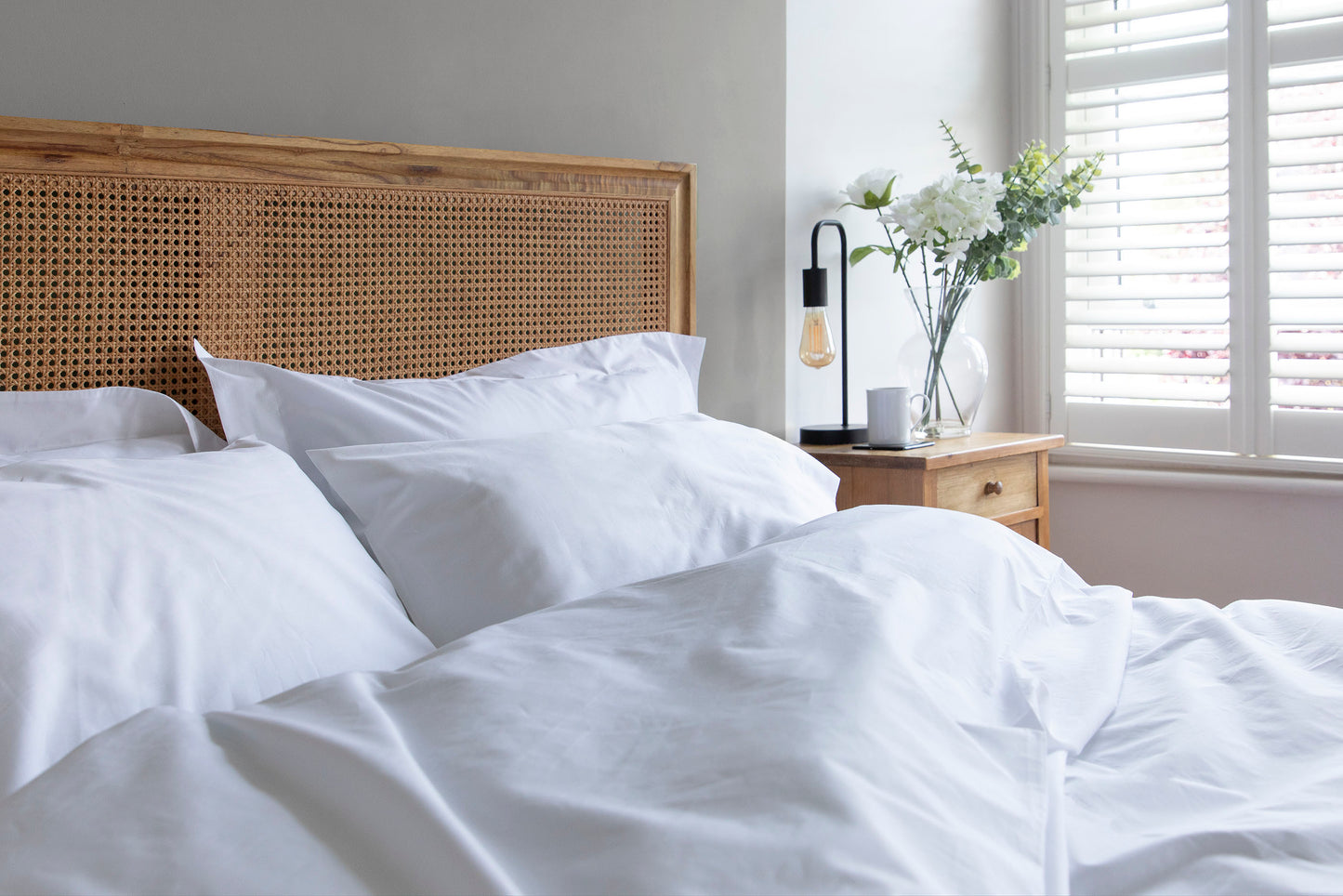
Better Than Black Friday - Flash Sale - 100% Pure Cotton bedding range, and luxurious handmade 100% European linen bedding.
Crafted for comfort. Priced for a limited time.

Choosing between cotton and linen bedding sounds straightforward until you begin comparing the different fabrics, weaves, finishes and claims about comfort. Both are natural fibres, both have been used for generations, and both can make beautiful, long-lasting bedding. Yet they offer noticeably different sleeping experiences.
At Linen Bay, we believe choosing bedding should be about more than appearance or thread count. It should be about how the fabric feels against your skin, how comfortable it keeps you throughout the night, how it fits into your lifestyle and whether it represents good value over time.
We work with both GOTS-certified organic cotton and European flax linen, and we have deliberately chosen to offer both rather than suggest that one material is universally better.
Our organic cotton collection includes crisp 270-thread-count percale and smooth 300-thread-count sateen, while our European linen is made from 100% flax, stone-washed for a relaxed finish and crafted in Lithuania.
Each material has its own character, advantages and limitations.
So, should you buy cotton or linen bedding?
For most people looking for immediate softness, a smooth finish and easy everyday comfort, high-quality cotton is an excellent choice. If you prefer a relaxed, textured feel, appreciate linen's distinctive appearance and want bedding that becomes more supple with use, European flax linen may be worth the additional investment.
The best choice ultimately depends on your sleeping preferences, budget and the qualities you value most.
In this guide, we'll explore the differences between cotton and linen bedding, including softness, breathability, durability, maintenance, sustainability and long-term value. We'll also explain how different cotton weaves compare with linen, helping you make a more informed buying decision.
Although cotton and linen are both plant-based fibres, they come from entirely different plants and have distinct characteristics.
Cotton is produced from the soft fibres surrounding the seeds of the cotton plant. These fibres are spun into yarn and woven into fabrics that can range from crisp and lightweight to silky-smooth and substantial.
Linen comes from the stalk of the flax plant. Flax fibres are naturally strong and have a different structure from cotton, creating a fabric with a distinctive texture, drape and appearance.
Both materials can be woven into high-quality bedding, but the finished result depends on much more than the fibre alone.
Yarn quality, fibre length, fabric weight, weave, finishing and manufacturing standards all influence how bedding feels and performs.
This is why comparing a cheap cotton sheet with premium European linen tells us relatively little about the underlying merits of either material.
A fair comparison needs to consider quality as well as fibre type.
Cotton is prized for its versatility.
Depending on the weave and finishing process, cotton bedding can feel crisp, smooth, cool, soft or gently lustrous.
It is also familiar to most sleepers. Many of us grew up with cotton sheets, and the sensation of freshly laundered cotton bedding is closely associated with a comfortable, welcoming bed.
At Linen Bay, our organic cotton bedding uses long-staple fibres, chosen for their contribution to yarn quality, softness and durability.
We offer two distinct cotton finishes:
Both are made from 100% organic cotton, yet they feel noticeably different.
This is an important point when choosing bedding: the weave can influence your experience almost as much as the fibre itself.
For a more detailed explanation, read our guide to which cotton is best for bedding, where we explore fibre quality, weave and the features that genuinely matter.
Linen has a character that is difficult to reproduce with other fabrics.
Made from flax fibres, it has a naturally textured surface, a relaxed drape and a distinctive appearance that becomes increasingly familiar and comfortable with use.
Unlike cotton sateen, which is designed to feel smooth and refined, linen embraces a more informal aesthetic.
Its natural creases are part of its appeal rather than something that necessarily needs correcting.
Linen is also valued for its strength, moisture management and ability to remain comfortable across different seasons.
At Linen Bay, our linen bedding is made from 100% European flax at approximately 160gsm.
It is stone-washed to soften the fabric and create the relaxed finish that many customers associate with premium linen bedding.
Our linen is crafted in Lithuania in small batches, reflecting a different approach to production from mass-market bedding.
If you're unfamiliar with linen, our article on the benefits of linen bedding explores its natural qualities in greater detail.
Softness is often the first consideration when choosing new bedding, but it is also one of the most subjective.
Some people associate softness with a smooth, almost silky surface. Others prefer a fabric that feels substantial, relaxed and naturally textured.
Neither preference is wrong.
One of cotton's greatest advantages is that good-quality cotton bedding can feel comfortable from the first night.
Cotton sateen is particularly appealing to people who enjoy a smooth, gently lustrous finish.
Its weave creates a surface that feels fluid and soft against the skin, making it an attractive option for those who dislike the more textured feel of linen.
Cotton percale offers a different sensation.
Rather than feeling silky, percale is crisp, fresh and lightly structured. It has the clean, cool-to-the-touch character many people associate with high-quality hotel bedding.
Percale usually becomes softer with laundering while retaining much of its characteristic crispness.
For anyone who enjoys climbing into a freshly made bed with smooth, cool sheets, cotton percale can be especially satisfying.
Linen feels different.
Even when stone-washed, linen generally retains more texture than cotton sateen.
Some sleepers love this immediately, while others need time to become accustomed to it.
One of linen's most appealing qualities is the way it changes with use.
With appropriate washing and regular use, the fibres tend to relax, and the fabric becomes more supple.
The result is bedding that gradually develops a comfortable, lived-in character.
However, it would be misleading to suggest that linen always becomes as smooth as cotton sateen.
It doesn't.
The two fabrics have fundamentally different textures, and that distinction remains part of their appeal.
If your priority is a smooth, silky-feeling surface, choose cotton sateen.
If you prefer fresh, crisp bedding, choose cotton percale.
If you enjoy natural texture and a relaxed feel that develops over time, choose linen.
The important thing is to understand what kind of softness you personally enjoy rather than assuming that one fabric is objectively softer than another.
Temperature comfort is one of the most common reasons people consider changing their bedding.
Anyone who regularly wakes feeling too warm will understand how much difference the right bedding can make to their sleeping environment.
Both cotton and linen are breathable natural fibres, but their performance depends on fabric construction, weight, room temperature, humidity and the other layers on your bed.
Linen is often recommended for warm sleepers because of its moisture-management properties and characteristic fabric structure.
Flax fibres can absorb moisture and release it as conditions change.
The texture and drape of linen bedding can also contribute to a comfortable sleeping environment, particularly when the fabric is lightweight and loosely arranged.
For some sleepers, this creates a pleasantly airy sensation.
Linen's appeal is not simply that it feels cool when first touched. It is the combination of breathability, moisture handling and the way the fabric sits around the body.
However, linen should not be described as a guaranteed solution to overheating.
A heavy duvet, warm mattress protector or poorly ventilated bedroom can still make a bed uncomfortable, regardless of the sheet material.
Cotton percale deserves equal consideration.
Its plain-weave construction produces a crisp, relatively lightweight fabric that many sleepers find comfortable in warmer conditions.
At Linen Bay, our 270TC organic cotton percale is designed to provide a fresh, breathable sleeping surface without the heavier sensation sometimes associated with dense bedding.
For people who prefer a smoother surface than linen but still want a crisp, airy feel, percale can be an excellent alternative.
Cotton sateen is also breathable, although its smoother weave and different drape can create a slightly more enveloping sensation.
This does not mean sateen is unsuitable for warm sleepers.
Individual comfort varies, and the overall bedding arrangement often matters more than a single fabric characteristic.
If you experience night sweats, choosing breathable bedding may improve comfort and help manage moisture.
However, night sweats can have many causes, and no bedding material should be presented as a medical treatment.
We explore practical fabric choices and bedroom considerations in our guide to the best bedsheets and bedding for night sweats.
For a textured, relaxed fabric with good moisture-management characteristics, linen is worth considering.
For a crisp, smooth and breathable alternative, cotton percale is an excellent choice.
We would not automatically recommend linen over cotton percale for every warm sleeper.
Personal preference, fabric weight and the rest of your bedding all deserve consideration.
A common misconception is that linen belongs exclusively in summer while cotton is better suited to winter.
In reality, both materials can be used throughout the year.
The warmth of your bed is influenced by the duvet's insulation, mattress, room temperature and the way bedding layers work together.
Cotton sateen can be particularly appealing during colder months.
Its smooth, gently draping finish creates a comfortable, enveloping sensation, especially when paired with a suitable winter duvet.
Cotton percale can also be used throughout winter, although some people find its crisp initial touch less inviting in a cold bedroom.
That sensation usually changes as the bedding warms against the body.
Linen is not inherently unsuitable for cold weather.
Although often associated with summer, linen can be layered with appropriate duvets, blankets and throws to create a comfortable winter bed.
Its natural texture also works beautifully with heavier seasonal layers.
For many people, linen's relaxed appearance is particularly attractive in autumn and winter, when bedrooms tend to feature warmer colours and more substantial textiles.
Rather than changing every item of bedding with the seasons, consider adjusting your duvet and additional layers.
A breathable sheet paired with a suitably insulated duvet can provide a comfortable arrangement across different temperatures.
Our guide to layering bedding for year-round comfort explores how to create a flexible bed using natural materials.
This is where the comparison becomes particularly useful.
Rather than treating cotton as a single type of bedding, we believe customers should understand the three distinct options available within the Linen Bay collection.
Our 270TC organic cotton percale is designed for people who appreciate the feeling of freshly laundered, crisp bedding.
Percale uses a plain weave, giving it a clean, matte finish and a lightly structured feel.
It is particularly well suited to:
Percale can crease naturally, particularly when made from pure cotton without synthetic easy-care treatments.
For some people, that is part of its authentic character. Others may prefer to iron it for a sharper appearance.
Our 300TC organic cotton sateen offers a different experience.
Its weave produces a smoother surface with a gentle lustre and fluid drape.
It is particularly appealing to:
Sateen's subtle sheen should not be confused with synthetic satin.
Cotton sateen is still made from cotton. The name describes the weave rather than a separate fibre.
Our 160gsm European flax linen is intended for people who appreciate natural texture and understated luxury.
Its stone-washed finish creates a relaxed appearance, while the flax fibres provide the distinctive feel associated with linen bedding.
It is especially suited to:
Linen's natural creasing is an essential part of its appearance.
If you want perfectly smooth, sharply pressed bedding every morning, cotton sateen or carefully ironed percale may be more appropriate.
Thread count is frequently used as a measure of bedding quality, but it is not a reliable indicator on its own.
It describes the number of yarns woven into a specified area of fabric.
While thread count influences fabric construction, it tells us relatively little about fibre quality, yarn strength or how the bedding will perform after repeated washing.
A well-made 270TC percale can be more desirable than a poorly manufactured fabric advertising a much higher thread count.
Similarly, our 300TC sateen has been selected for its balance of comfort, weave and quality rather than simply to achieve the largest possible number.
Linen is generally assessed differently.
Fabric weight, fibre quality, construction and finishing are often more meaningful considerations than thread count.
Our European linen is approximately 160gsm, offering a balance between substance and comfortable drape.
Ultimately, we believe customers should look beyond marketing numbers and consider the quality of the complete fabric.
For a closer comparison of the cotton weaves, read the difference between percale and sateen weaves explained.
Linen has a longstanding reputation for strength and durability.
Flax fibres are naturally strong, and well-made linen can provide many years of use when properly cared for.
However, that does not mean every linen sheet will outlast every cotton sheet.
Fabric quality, weave, finishing, laundering and everyday use all influence longevity.
Linen's strong fibres make it suitable for products intended for repeated use and laundering.
Well-constructed linen can retain its usefulness over many years, gradually becoming more supple.
This long service life is one reason some customers consider linen worth a higher initial investment.
Nevertheless, linen is not indestructible.
Repeated abrasion, excessive heat, harsh detergents and poor washing practices can damage linen just as they can other natural fabrics.
Areas exposed to concentrated wear, such as fitted sheets, may also deteriorate sooner than less heavily used bedding.
High-quality cotton can also be extremely durable.
The length and quality of the cotton fibres, together with the yarn and weave, play an important role.
Long-staple cotton can be spun into finer, more uniform yarns, helping manufacturers produce fabrics with a desirable balance of strength and softness.
At Linen Bay, we select long-staple organic cotton because we believe fibre quality is more meaningful than relying on thread count alone.
Percale and sateen also wear differently.
Percale's plain weave can provide excellent durability, while sateen's longer exposed yarn floats may be more vulnerable to snagging or abrasion under certain conditions.
This is not a reason to avoid sateen, but it is worth understanding when choosing bedding for frequent use.
Premium linen has excellent potential longevity, but premium cotton can also provide years of comfortable service.
We would not promise that linen will last a particular number of years longer than cotton without comparable testing.
Instead, we recommend investing in well-made bedding, following the care instructions and choosing a fabric suited to how you actually use your bed.
Practical maintenance is often overlooked when choosing luxury bedding.
A fabric may look beautiful in photographs, but if it requires more care than you are comfortable providing, it may not be the right choice.
Both cotton and linen can be practical everyday materials, provided they are washed and dried according to their care labels.
Cotton is familiar and generally straightforward to maintain.
For most cotton bedding, we recommend:
Cotton percale may require ironing if you prefer a particularly crisp, hotel-style finish.
Cotton sateen can look smoother naturally, although it is not completely crease-free.
Neither should be described as requiring no ironing under all circumstances.
Linen is often easier to live with than customers initially expect.
Its naturally creased appearance means there is usually little reason to iron it unless you prefer a more formal finish.
Regular, appropriate washing helps linen develop its characteristic softness.
However, linen should still be treated with care.
Excessive heat, aggressive washing and unsuitable drying can affect the fibres, appearance and fit.
Stone-washed linen may have a relaxed appearance from the beginning, but this does not remove the need to follow the manufacturer's care instructions.
For more practical advice, see our complete guide to caring for linen and cotton bedding.
If avoiding ironing is a priority, linen can be an attractive option because its natural creases are part of the intended aesthetic.
Cotton sateen is another good choice if you prefer a smoother appearance without necessarily seeking a perfectly pressed finish.
Cotton percale may require more attention if you want it to look exceptionally crisp.
Our advice is simple: choose bedding that looks attractive to you even when it has been washed and used naturally.
Sustainability is an important consideration when choosing natural bedding, but comparisons between cotton and linen are often oversimplified.
You may have read that linen is always more sustainable because flax requires less water, or that organic cotton is automatically environmentally superior to conventional cotton.
The reality is more complex.
Environmental impact depends on growing conditions, irrigation, agricultural inputs, processing, energy use, transport, product lifespan and other factors.
Flax can be grown in suitable European climates with relatively low irrigation requirements.
It is also a versatile crop, with different parts of the plant potentially used for different purposes.
These characteristics make European flax an attractive natural fibre.
However, growing flax is only one stage of linen production.
Retting, fibre processing, spinning, weaving, finishing and transport all contribute to the finished fabric's environmental footprint.
The origin of the flax, manufacturing methods and product lifespan therefore matter.
At Linen Bay, our linen is made from European flax and crafted in Lithuania.
We value the material's natural character and the skilled manufacturing involved in turning flax into finished bedding.
Cotton production varies considerably.
Conventional cotton farming can involve substantial irrigation and agricultural inputs, depending on the region and growing methods.
Organic cotton is produced under standards that restrict certain synthetic pesticides and fertilisers and require specific agricultural practices.
However, organic certification does not mean that cotton requires no water or has no environmental impact.
At Linen Bay, our cotton bedding is GOTS-certified and also carries OEKO-TEX® Standard 100 certification.
These certifications address different aspects of textile production and product safety.
GOTS provides requirements relating to organic textile processing, environmental practices and social criteria, while OEKO-TEX® Standard 100 focuses on testing textiles for harmful substances.
They are meaningful distinctions, but they should not be treated as interchangeable or as proof of a completely impact-free product.
We do not believe there is a responsible universal answer.
European flax linen can have environmental advantages in particular growing and production circumstances.
Certified organic cotton also offers a more accountable alternative to cotton produced without comparable standards.
A complete comparison would require reliable lifecycle data for the specific products involved.
Longevity matters too.
Bedding that remains comfortable and useful for many years may reduce the need for frequent replacement, although this depends on how it is manufactured, cared for and used.
Our detailed article on sustainable linen versus cotton bedding explores these considerations further.
For Linen Bay, the aim is not to declare one natural fibre morally superior to another. It is to offer carefully selected materials with meaningful quality and certification standards.
Price is often the deciding factor when comparing cotton and linen bedding.
Linen commonly carries a higher retail price, particularly when made from quality European flax and manufactured in smaller batches.
There are several reasons for this.
Turning flax into usable linen yarn involves several stages.
The plant must be harvested, its fibres separated and prepared, and those fibres spun and woven into fabric.
These processes require specialist knowledge and equipment.
The quality of the finished linen also depends on fibre selection, yarn preparation, weaving and finishing.
Cotton is produced and processed globally on a very large scale.
This creates a wide range of manufacturing options and price points.
Linen production is generally smaller in scale, particularly within specialist European supply chains.
At Linen Bay, our linen bedding is crafted in Lithuania in small batches rather than being produced as an unrestricted mass-market range.
This approach influences production and lead times, but it also reflects the way our linen collection is made.
Not necessarily.
A higher price does not automatically make linen more comfortable, more durable or more suitable for your needs.
Some customers will find the additional cost entirely worthwhile because they love linen's texture, appearance and character.
Others will be happier with premium cotton, especially if they prefer a smoother finish.
We believe value should be judged by how much you enjoy using the bedding, its quality, its expected useful life and whether it suits your lifestyle.
For someone who genuinely enjoys linen, it can be.
Its natural texture, relaxed styling and tendency to soften with use create a distinctive experience.
But if you dislike textured bedding or prefer the smoothness of cotton sateen, paying more for linen may not improve your sleep experience.
Expensive bedding is only good value when it meets your needs.
People with sensitive skin often pay particular attention to bedding materials.
Both cotton and linen are natural fibres, but neither should automatically be described as hypoallergenic or suitable for every skin condition.
Individual reactions can depend on fabric texture, dyes, finishing agents, detergents and other factors.
High-quality cotton can be particularly appealing to people who prefer minimal surface texture.
Cotton sateen provides a smooth finish that some sleepers find comfortable against sensitive skin.
Cotton percale also offers a clean, breathable surface, although its crispness may feel different.
For people who dislike friction or rough-feeling fabrics, a smooth cotton weave may be preferable to textured linen.
Linen can also be comfortable for sensitive sleepers, particularly once it has softened through use.
However, its characteristic texture may not appeal to everyone.
Someone with very sensitive skin may prefer to feel linen before committing to a complete bedding set.
OEKO-TEX® Standard 100 certification provides reassurance that the tested textile meets specified limits for harmful substances.
It does not guarantee that a person will never experience irritation or an allergic reaction.
Similarly, organic cotton certification should not be confused with medical suitability.
If skin sensitivity is an important concern, we recommend considering the complete bedding arrangement, washing products and your own experience with different fabrics.
Luxury means different things to different people.
For some, it is a perfectly made bed with smooth white sheets and crisp edges.
For others, it is an inviting arrangement of natural textures, soft folds and relaxed layers.
Cotton and linen can both create luxurious bedrooms, but their visual characters are different.
Cotton percale is ideal for a clean, structured bed.
It works particularly well in traditional, contemporary and hotel-inspired bedrooms.
White or softly coloured percale bedding can create a fresh, understated appearance.
Cotton sateen brings a slightly different quality.
Its subtle lustre and fluid drape can make a bedroom feel elegant and refined without the artificial shine associated with some synthetic fabrics.
Linen has become closely associated with informal, contemporary interiors.
Its texture, gentle creasing and relaxed drape work particularly well with natural wood, muted colours and layered textiles.
It can feel luxurious without looking overly styled.
For many people, that effortless quality is precisely the attraction.
Absolutely.
In fact, combining cotton and linen can create a particularly attractive and practical bed.
You might choose crisp cotton percale fitted sheets beneath a relaxed linen duvet cover, or pair smooth cotton pillowcases with textured linen bedding.
Mixing the materials allows you to enjoy their different qualities while creating visual depth.
Our article on creating a luxury bedroom with cotton and linen bedding explores this approach in more detail.
A useful buying guide should explain the limitations of a material as clearly as its advantages.
Cotton is an excellent bedding fibre, but it is not perfect.
Depending on the weave and quality, cotton bedding can crease, shrink if washed incorrectly or show signs of wear over time.
Percale may feel too crisp for someone who prefers a very soft, draping fabric.
Sateen can be more susceptible to snagging or surface abrasion because of its weave structure.
Cotton also varies enormously in quality.
A label stating 100% cotton tells you the fibre composition, but not whether the yarn, construction or finishing is particularly good.
Environmental impact is another consideration, particularly where cotton is produced without meaningful agricultural or manufacturing safeguards.
These are reasons to choose carefully rather than avoid cotton altogether.
For a balanced examination, read what are the disadvantages of 100% cotton.
Linen also has limitations that customers deserve to understand before buying.
The most obvious is price.
Good-quality European linen often costs more than comparable cotton bedding, which may make it less accessible for some households.
Its texture is another consideration.
Although stone-washing and repeated laundering can make linen softer, it generally retains more natural texture than smooth cotton sateen.
Linen also creases readily.
Many people love this appearance, but it will not appeal to someone who wants perfectly smooth bedding.
Depending on the construction and finishing, linen can initially feel firmer than expected.
It also requires appropriate laundering and drying to preserve its appearance and fit.
Finally, linen's natural appearance can sometimes be misunderstood.
Minor variations in texture and the way the fabric drapes are part of its character, rather than evidence that it should resemble a perfectly uniform synthetic textile.
For customers who appreciate those qualities, linen can be wonderful.
For those who don't, cotton may be the more satisfying choice.
Having considered the technical differences, the most useful question is how those differences translate into everyday choices.
Our recommendation: Organic cotton percale.
Its fresh, structured feel and matte finish make it ideal for customers who enjoy a neatly made bed and crisp sheets.
It offers a familiar hotel-inspired experience without requiring an exceptionally high thread count.
Our recommendation: Organic cotton sateen.
Its smooth surface and fluid drape make it an excellent choice for people who prioritise immediate softness.
It is also worth considering if you find linen's texture too pronounced.
Our recommendation: European flax linen.
Linen's texture, natural creasing and relaxed drape are central to its appeal.
It is particularly attractive for customers who want a timeless, informal bedroom style.
Our recommendation: Cotton percale or European linen.
Both can be excellent choices.
Percale is ideal if you prefer a crisp, smooth sleeping surface, while linen may appeal if you enjoy its texture and moisture-management characteristics.
We would not claim that one is guaranteed to keep every sleeper cooler.
Our recommendation: European linen, or cotton sateen if you prefer a smoother look.
Linen's relaxed creases are generally accepted as part of its appearance.
Sateen can provide a relatively smooth-looking finish, although neither fabric is completely wrinkle-free.
Our recommendation: Cotton percale or sateen.
Percale suits a crisp, tailored appearance, while sateen provides a softer, more fluid finish.
Both work beautifully with neutral colours and carefully layered bedding.
Our recommendation: Choose quality first, then fibre.
Premium cotton and premium linen can both represent excellent value.
The right decision depends on your budget, preferences and how well the bedding is cared for.
We would rather someone buy high-quality cotton they genuinely love than spend more on linen simply because it is perceived as the more luxurious material.
When developing Linen Bay, one of our priorities was to avoid treating bedding as a product defined by a single impressive number or marketing claim.
We wanted to understand what genuinely makes bedding comfortable and desirable over time.
That meant considering fibre quality, weave, fabric weight, finishing, manufacturing and the practical details customers encounter every day.
It also meant recognising that different customers want different things.
Someone looking for crisp, hotel-style sheets may have very little interest in linen's relaxed texture.
Equally, someone who loves the natural character of flax linen may find conventional cotton bedding too smooth or structured.
Neither customer needs persuading that their preference is wrong.
Our approach has therefore been to offer three distinct fabric experiences rather than one supposedly perfect solution.
We selected long-staple organic cotton because fibre quality contributes to the character and performance of the finished fabric.
We also wanted to offer different weave options.
Our 270TC percale provides the crispness associated with classic cotton bedding, while our 300TC sateen offers a smoother alternative.
Both are GOTS-certified and OEKO-TEX® Standard 100 certified, giving customers clearer information about the standards associated with the products they are purchasing.
For our linen collection, we chose 100% European flax with a 160gsm fabric weight.
We wanted linen that retained its natural character while offering the relaxed finish customers expect from stone-washed bedding.
Our Lithuanian manufacturing arrangement also reflects our preference for considered production in small batches.
This does mean linen orders have a longer lead time than some mass-produced alternatives, something we believe customers should understand before purchasing.
Fabric choice is only part of the bedding experience.
A fitted sheet needs to fit the mattress properly.
A duvet cover should be straightforward to use.
Pillowcases should hold pillows comfortably.
These practical details influence whether customers enjoy their bedding long after the initial purchase.
Our cotton and linen fitted sheets are available in standard 30cm and deep 35cm options, helping customers select a suitable fit for their mattress.
We also pay attention to construction details such as duvet cover fastenings and internal corner ties.
These may sound like small considerations, but they can make a meaningful difference to everyday use.
Ultimately, our aim is not to convince everyone to buy the most expensive material.
It is to help customers choose bedding they will genuinely enjoy living with.
Neither material is universally better.
Linen may appeal to people who enjoy textured, relaxed bedding and value its moisture-management properties.
Cotton may be preferable for those who want a smoother surface, immediate softness or a crisp hotel-style finish.
The best material depends on individual comfort and preferences.
Linen is often associated with comfortable warm-weather sleeping because of its moisture-management properties and natural fabric structure.
However, lightweight cotton percale can also be very comfortable in warmer conditions.
Fabric weight, weave, duvet choice and bedroom temperature all influence how cool bedding feels.
Many hotels use cotton bedding, often favouring smooth or crisp white fabrics that suit their desired appearance and laundering requirements.
However, bedding choices vary between properties, and some hotels use linen or blended materials.
For more information, read our guide to what bedding is used in five-star hotels.
Linen generally becomes more supple with appropriate washing and use, particularly during its earlier life.
However, the rate of change depends on the fabric and finishing.
It will not necessarily become as smooth as cotton sateen, because the fibres and fabric structures are different.
Pure cotton is often preferred by customers who value natural fibres and their characteristic comfort.
However, blends can offer practical advantages such as reduced creasing or different durability characteristics.
The best choice depends on the materials used and what you want from your bedding.
Linen fibres are naturally strong, and high-quality linen can be long-lasting.
However, there is no guarantee that every linen product will outlast every cotton product.
Manufacturing quality, construction, frequency of use and care are all important.
Linen can be worth the additional cost if you enjoy its texture, relaxed appearance and the way it develops with use.
If you prefer smooth, crisp or silky bedding, premium cotton may offer better personal value.
Yes.
Combining cotton sheets with a linen duvet cover is an excellent way to enjoy the different qualities of both materials.
For example, crisp cotton percale sheets can work beautifully beneath a relaxed linen duvet cover.
Certified organic cotton is produced and processed according to defined standards, depending on the certification scheme.
This can provide meaningful environmental and supply-chain assurances.
However, organic cotton is not automatically softer or more durable than conventional cotton. Fibre quality, weave and manufacturing still matter.
All three options — cotton percale, cotton sateen and linen — can be suitable for everyday use.
Cotton percale is ideal for a crisp, fresh feel.
Cotton sateen suits people who prefer smooth softness.
Linen appeals to those who enjoy natural texture and a relaxed appearance.
Choose the fabric that best suits your comfort preferences and willingness to care for it.
After comparing cotton and linen across comfort, breathability, softness, durability, maintenance, sustainability and value, our conclusion is straightforward.
There is no single best bedding material for everyone.
If you want crisp, fresh sheets with a classic hotel-inspired feel, high-quality cotton percale is difficult to beat.
If your priority is immediate softness and a smooth, refined surface, cotton sateen is an excellent choice.
If you love natural texture, relaxed styling and a fabric that develops character over time, European flax linen may be the ideal investment.
We also believe the differences between individual fabrics matter more than broad claims about cotton or linen being universally superior.
A carefully made cotton sheet can be more comfortable and longer-lasting than poorly constructed linen.
Equally, high-quality linen can offer a distinctive experience that some sleepers would never exchange for cotton.
The most important decision is to choose bedding that suits your own preferences rather than following a trend.
At Linen Bay, we offer both because we genuinely believe they deserve a place in a thoughtfully considered bedroom.
Explore our GOTS-certified organic cotton bedding collection if you prefer crisp percale or smooth sateen, or discover our pure linen bedding collection if you're drawn to the natural character of European flax.
Whichever material you choose, our aim remains the same: carefully made natural bedding, designed for lasting comfort and a better night's sleep.
Naturally Better Sleep.